
Publications
Academic Books
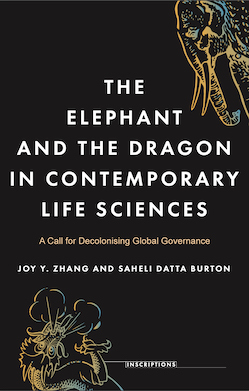
Zhang, J. Y. and Datta Burton, S (2022) The Elephant and the Dragon in Contemporary Life Sciences: A Call for Decolonising Global Governance. Manchester University Press. ~ [This book provides a powerful diagnosis of why the global governance of science struggles in the face of emerging powers. It demonstrates that the ‘subversiveness’ assumed in China’s and India’s rise in the life sciences reflects many of the regulatory challenges that are shared globally. It stresses a decolonial imperative for science governance to be responsive and effective in a cosmopolitan world. ] Now in paperback!

Zhang, J. Y. and Barr, M (2013) Green Politics in China: Environmental Governance and State-Society Relations, London: Pluto Press ~[‘This book should be read by all those with an interest in the future of our planet’- Tony Saich, Professor of International Affairs, Harvard University]
Zhang, J. Y. (2012) The Cosmopolitanization of Science: Stem Cell Governance in China, Basingstoke: Palgrave Macmillan ~[Nominated for the BSA Philip Abrams Memorial Prize; ‘This is a highly original, ground breaking study as it enriches cosmopolitan theory with empirical data from a developing country.’ – Ulrich Beck]
Non-fiction

Zhang, J. Y. (2017) 小世界:在欧洲做学术的注脚(Small World: Footnotes to Academic Observations), Beijing: 三联书店 SDX Joint Publishing Company ~[Listed as one of the Impactful Books (non-fiction/popular science category) of 2017]
Articles
Zhang, J. Y. (2025) ‘Scandalous “Firsts” from the Global South? The Entanglement between Epistemic Injustice and Responsible Research and Innovation (RRI).’ Journal of Responsible Innovation, 12(1): https://doi.org/10.1080/23299460.2025.2557066 (open access) [By analysing two kinds of scientific scandals—described as ‘science out of place’ and ‘science out of pace’—this paper highlights both the challenges and opportunities for RRI to ‘de-link’ from hegemonic perceptions of legitimacy in science and to promote productive epistemic socialisation.]
Zhang, J. Y. (2024) ‘ Science Diplomacy and China’s New “Self-Prioritizing” Development Mindset‘, Science & Diplomacy,https://doi.org/10.1126/scidip.adt9926 [How China has transitioned from an emerging to an assertive scientific power, and how its evolving diplomatic strategy corresponds with and reinforces a generational shift in mindset toward the world.]
Namdeo, S and Zhang, J. Y. (2024) ‘ Rethinking Science Diplomacy and Global Biosecurity: Challenges, Emerging Practices and the Way Forward‘, International Affairs, 2024; iiae187 [PDF] [How the global phenomenon of ‘science at large’ has given rise to two key trends in global biosecurity governance: an increased reliance on science diplomacy to address biosecurity concerns and the rise of ‘distributed agencies’, particularly involving young practitioners from the global South]
Zhang, J. Y. (2023) ‘‘Commoning genomic solidarity to improve global health equality’. Cell Genomics, 3(10), 100405 [PDF] [Why contemporary “genomic sovereignty” framing paradoxically undermines rather than protects the public good in Global South communities.]
Zhang, J. Y. Ben Ouagrham-Gormley S. and Vogel, K. (2023) ‘Chinese Academics Are Becoming a Force for Good Governance’. Issues in Science and Technology, 39(4), 81-84. [PDF] [How did Chinese academics see the three International Summits on human genome editing?]
Zhang, J. Y. (2023) ‘Decolonising the temporal and relational assumptions in contemporary science and science policies’. Critical Policy Studies, 17, 162-174 [PDF] [What it means to see global Others ‘contemporaneously’ and why it matters.]
Zhang, J. Y. and Ruipeng Lei. (2023) ‘Is Chinese Bioethics Ready to Move Forward from the CRISPR Baby Scandal?’, Hastings Bioethics Forum, 6 March 2023 [Implications and loopholes of China’s new national ethics review guidelines endorsed by four ministries]
Zhang, J. Y and Srinivas, K.R. (2023) ‘Bioeconomy for the Common Good: A Myth, A Sham or An Inspiration?’ Asian Biotechnology & Development Review, 25(1-2), 1-4 [PDF] [This special issue was launched by Dr Renu Swarup, former secretary of India’s Department of Biotechnology at the G20 event, ‘BioGovernance and Science Diplomacy’ I co-hosted with the RIS on 18th Aug.]]
Zhang, J. Y. (2023) ‘What Do the British and Chinese Governing Visions on Human Genomic Research Tell Us about Biosovereignty?’, Asian Biotechnology & Development Review, 25(1-2), 5-23 [PDF] [Why data circulation matters and how ‘biosovereignty’ has become a misguiding lens.]
Shepherd, J. and Zhang, J. Y. (2023) ‘Combating the “Silent Crisis” of the Donation Gap with “Polyphonic Relatedness”’, Asian Biotechnology & Development Review, 25(1-2), 57-67 [PDF][preliminary report on our ongoing project on increasing stem cell donations from minority communities]]
Zhang, J. Y. (2022) ‘The Hegemonic Paradox of Science Diplomacy and Its Contemporary Challenges: Lessons from the COVID Pandemic’, Science Diplomacy Review, 4(3), 17-30 [PDF] [The article makes visible a hegemonic rationale embedded in modern science diplomacy through a comparison between US and China]
Zhang, J. Y., Balakrishnan, B., Sriniva, R. and Sundberg, T. (2022) ‘What new dimensions are needed for science diplomacy?’, Science Diplomacy Review. 4(3), 1-4. [PDF] [‘Can diplomacy be save? Can diplomacy save us?’ An introduction to a special issue]
Zhang, J. Y., Ben Ouagrahm-Gormley, S. and Vogel, K. (2022) ‘Creating Common Ground With Chinese Researchers‘, Issues in Science and Technology, pp. 45-48. [PDF]. [Our preliminary reflections on how researchers can come together amid rising international political tensions.]
Zhang, J. Y. (2021) ‘Will health diplomacy of the South balance global inequality?’ Georgetown Journal of International Affairs,22(2), 287-294. [An examination on the roles of medical popularism and soft power in emerging powers’ regional and global strategies.]
Zhang, J. Y. (2021) ‘(Bio)Politics of Existence and Social Change: Insights from the Good Food Movement’, Sociological Review, 69(3) 647–663 [PDF]~ [How to track the impact of social movement in societies that do not easily fit with Western neoliberal theorisations? This paper proposes an analytical lens of the ‘biopolitics of existence’ to address this problem. The term existence refers to the ‘corporeal’ needs of survival as well as the freedom to develop and the ability to interact with others.]
Zhang, J. Y. (2021) ‘To keep nationalism in check, nurture science solidarity’ Nature, 591, 9. ~[A short piece on how Western media may unwittingly help reinforce a nationalist rhetoric in China and what the scientific community can do to promote openness]
Li, Jun; Liangjie Ye, Yimin Zhou, Joy Y. Zhang and Zhou Chen (2021) ‘To procrastinate or not to procrastinate: A retrospective study of the optimal timing of containing the global spread of the COVID-19 pandemic’, Frontiers in Public Health. 9, https://doi.org/10.3389/fpubh.2021.613980 [PDF] [A quantitive study that demonstrates timing is a most significant factor in effective control of COVID-19]
Zhang, J. Y. and Barr, M. (2021) ‘Harmoniously Denied: COVID-19 and the Latent Effects of Censorship’. Surveillance and Society. 19(3):389-402 [PDF] ~[The paper brings surveillance and censorship discussion together through a Foucauldian examination]
Xie, L. and Zhang, J. Y. (2020) ‘”Just sustainability” or just sustainability? Shanghai’s failed drive for global excellence’. Society and Natural Resources, 34(4), 449-466. [PDF] ~ [A Bourdieuian lens on the subaltern struggle with sustainability]
Zhang, J. Y. and Barr, M. (2019) ‘The Transformative Power of Commoning and Alternative Food Networks‘. Environmental Politics, 28(4), 771-789. [PDF] ~ [Why we need to combine the commoning framework and social movement theories to make visible the constituent effects of AFNs]
Zhang, J. Y. (2018). ‘Cosmopolitan Risk Community in a Bowl: A Case Study of China’s Good Food Movement‘. Journal of Risk Research, 21:68-82. [PDF]~ [What Ulrich Beck got wrong about the coming together of a cosmopolitan community in the face of collective risk]
Zhang, J. Y. (2018). ‘How to be modern? The social negotiation of ‘good food’ in contemporary China‘. Sociology, 52(1) 150–165. [PDF] [Shortlisted for 2019 SAGE Prize for Innovation/Excellence]
Zhang, J. Y. (2017). ‘Lost in Translation? Accountability and Governance of Clinical Stem Cell Research in China‘. Regenerative Medicine, 12(6), 647–656. [PDF]~ [China’s ‘post-hoc’ pragmatism and its unintended side-effects]
Zhang, J. Y. (2017). ‘Transparency Is a Growth Industry’, Nature, 545, S65. [PDF]
Zhang, J. Y. (2015). ‘The ‘credibility paradox’ in China’s science communication: Views from scientific practitioners‘. Public Understanding of Science, 24(8), 913-927 [PDF]~ [How even in authoritarian societies, ‘civic’ epistemology plays a significant role in validating scientific knowledge]
Zhang, J. Y. (2015) ‘Cosmopolitan Risk Community and China’s Climate Governance‘, European Journal of Social Theory. 18(3), 327-342 ~[How engaging with the intersectionality of the cosmopolitan space help to decipher the power dynamic in collective problem solving]
Zhang, J. Y. and Barr, M. (2013) ‘Recasting Subjectivity Through the Lenses: New Forms of Environmental Mobilisation in China’, Environmental Politics, 22(5), 849-865 [PDF] ~ [Visual images are not merely exhibiting but also producing new forms of subjectivity]
Beck, U; Blok A; Tyfield D and Zhang, J. Y. (2013) ‘Cosmopolitan Communities of Climate Risk: Conceptual and Empirical Suggestions for a New Research Agenda’, Global Networks, 13(1), 1-21
Zhang, J. Y. (2012) ‘The Art of Trans-boundary Governance of Synthetic Biology’, Systems and Synthetic Biology, 7(3), 107-114 [PDF]
Zhang, J. Y. and Arnoldi, J. (2012) ‘The dual reality in the institutionalization of the Chinese knowledge economy’, International Journal of Chinese Culture and Management, 3(2), 160-173 [PDF]
Zhang, J. Y. (2011) ‘The “National” and “Cosmos”: The emergence of synthetic biology in China‘. EMBO Reports, 12(4), 302-6 [PDF]
Zhang, J. Y. (2011) ‘Scientific institutions and effective governance: a case study of Chinese stem cell research’. New Genetics and Society, 30(2): 193-207 [PDF]
Zhang, J. Y. (2010) ‘Is the cosmopolitanization of science emerging in China?’ Études Internationales. 41, 571-595 [PDF]
Zhang, J. Y. (2010) ‘The cosmopolitanization of science: Experience from China’s stem cell scientists’. Soziale Welt (Special issue in English). 61: 255-274 [PDF]
Zhang, J. Y. (2010) ‘The organization of scientists and its relation to scientific productivity: Perceptions of Chinese stem cell researchers’, Biosocieties. 5(2): 219-235 [PDF]
Policy & Project reports
Joy Y. Zhang, Ruipeng Lei, Kathleen Vogel, Sonia Ben Ouagrham-Gormley (2023) Looking Back into the Future: CRISPR and Social Values: BioGovernance Common’s Open Discussion with Chinese Academics. 13 February. Canterbury: Centre for Global Science and Epistemic Justice, University of Kent [PDF]
Centre for Global Science and Epistemic Justice (2022) The Ethics of Protecting ‘CRISPR Babies’: An International Roundtable Summary Report. Canterbury: University of Kent [PDF]
Zhang, J. Y. He, G. Zhang, W. (2019) ‘Overturning the “doing-comes-before-talking” mentality, building China’s leadership in global science governance’. Zhanlve Yanjiu Cankao战略研究参考 (内参, Internal Policy Recommendation to China’s Ministry of Science and Technology). 386, 1-4
Zhang, J. Y. (2018) Governing Scientific Accountability in China. Final Report of the ESRC Research Project. Canterbury: GSA-China.[PDF]
Zhang, J.Y. Marris, C. and Rose, N. (2011) The Transnational Governance of Synthetic Biology: Scientific uncertainty, cross-borderness and the ‘art’ of governance. BIOS Working Paper prepared for the Royal Society Science Policy Centre (UK), May 2011 [PDF]
Book chapters
Zhang, J. Y. (2022) ‘The Dual Role of Risk in Mitigating Socio-Political Inequality: A Case Study on the Cosmopolitanization of Science’. in: Curran, D. eds, Handbook on Risk and Inequality. Cheltenham: Edward Elgar Publishing.
Zhang, J.Y. (2021) ‘Harmoniously Denied: China’s Censorship on COVID-19’. In: Bringel B.and Pleyers G. ed. Social Movements and Politics in a Global Pandemic: Crisis, Solidarity and Change. Bristol: Bristol University Press
Zhang, J. Y. (2020) ‘Globalisation, Cosmopolitanisation and a New Research Agenda’. In: Rossi, I, eds. Challenges of Globalization and Prospects for an Inter-civilizational World Order. Springer.
Zhang, J. Y. (2017). ‘Relaciones entre el Estado y las ONG en China: Una simbiosis controvertida’. in: Bringel, B. and Pleyers, G. eds. Movimientos sociales en los años 2010: crisis, indignación y polarización. Buenos Aires: CLACSO.
Zhang, J. Y. (2014) ‘Synethsizing the “national” and the “cosmos”: the case of life sciences in China’, in Yasemin Soysal eds. Transnational Trajectories in East Asia: Nation, Citizenship and Region, New York: Routledge
Zhang, J. Y. (2014) ‘Does Chine Offer a New Paradigm for Doing Science?’ in David Kerr eds. China’s Many Dreams: Comparative Perspectives on China’s Search for National Rejuvenation. Basingstoke: Palgrave Macmillan
Beck, U. and Zhang, J. Y. (2012) ‘Reflexivity’ in Wiley-Blackwell Encyclopedia of Globalization, Published Online: 29 Feb 2012
Lentzos, F; Cockerton C; Finlay S; Hamilton R.A.; Zhang J.Y. and Rose, N. (2012) ‘The Societal Impact of Synthetic Biology’, in Baldwin et al (eds) Synthetic Biology: A Primer. London: Imperial College Press
Barr, M and Zhang, J. Y. (2010) ‘China: bioethics education, biosecurity,and the rise of its science’ inB. Rappert ed.Ethics, Education, and the Life Sciences, Canberra: Australian National University Press. [PDF]
Zhang, J. Y. (2009) ‘The Regulation of China’s Stem Cell Research in the Context of Cosmopolitanization’, in O. Doering ed. Life Sciences in Translation: A Sino-European Dialogue on Ethical Governance of the Life Sciences, London: BIONET
 Joy Zhang