
New Book -Out 15 March!
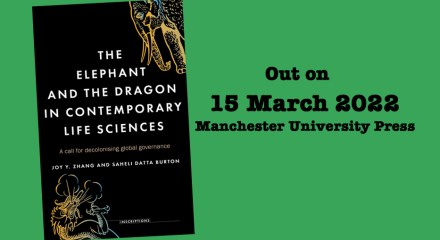
This book discusses how the global governance of science can be improved in the face of emerging powers. The rise of India’s and China’s life sciences are used as examples. We use the terms ‘elephant’ and ‘dragon’ metaphorically. That is, China and India are both seen as emerging ‘dragons’ and as ‘elephants’. Both countries have … Continue reading
New Book, New Project, New Centre
It’s been a few busy months but I’m delighted to say that it has also been quite productive. New Book: my next book, Democratic Participation and the Cosmopolitics of Science, is now under contract with Springer. It will be part of their ‘Emerging Globalities and Civilizational Perspectives’ series. I’m quite excited about this writing project, … Continue reading
Decolonizing Risk Sociology
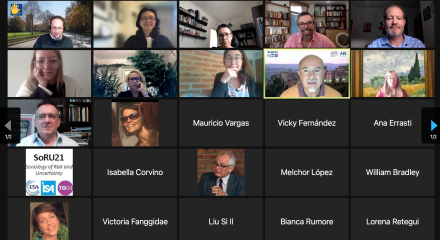
What a better way to kick off the reading week (half term break in UK universities) in a teaching-heavy term than being part of a discussion on decolonisation with leading risk theorists across different time zones? I enjoyed every bit of it which makes me miss in-person meetings. If this were in-person, some the discussions … Continue reading
BioGovernance Commons Launched!

China is the world’s second largest investor in science and a leading research powerhouse. Over the past two decades, the vast government investment in science has propelled China from the ninth-largest biomedical sector in 2006 to the fourth place in 2015, and in 2021 China reached the second place (after the U.S.) in biological science. … Continue reading
Media and New Editing Roles
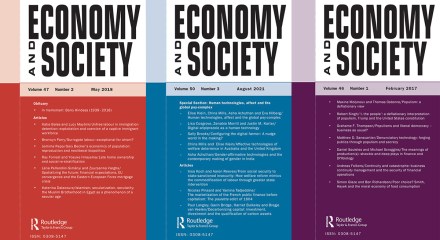
Summer is not just for conferences but also for new collaborations and new beginnings. I was really glad to receive the invitation to join the editorial board of Economy and Society. I was also delighted to join the book project, Routledge Handbook of Global Political Participation. I’ll lead the sections relating to science and technology … Continue reading
Runner-Up Research and Innovation Prize 2021
Glad to be the runner-up for University of Kent’s Consolidator Research Prize this year. The other runner-up was Dr Marina Ezcurra at the School of Biosciences, who explores microbiota as an avenue for novel treatments to cognitive problems during ageing. This year’s winner was Dr Jennifer Hiscock at the School of Physical Sciences, whose research … Continue reading
Globalisation, Cosmopolitanization, and a New Research Agenda
I’m very pleased to receive this collected volume edited by Ino Rossi. I can only imagine the amount of editing work that was put into this volume. For myself, I actually drafted two very different pieces for this book. The original piece was more empirical and regional focused, but later Into and I both decided … Continue reading
New piece in Nature
I think everyone is getting tired of the politicisation of COVID and the blame games – both Chinese and Western politicians bear responsibilities. Yet the victims of China-bashing are not limited to China and its citizens. It has serious implications for global science. Here is my short piece on how Western media may unwittingly help … Continue reading
Oct 2019 – NSF success!
I’m delighted to say that the project, Ethical Issues Surrounding Human Germline Genome Editing, that I’ve been developing with Kathleen Vogel (PI, University of Maryland) and Sonia Ben Ouagrham-Gormley (George Mason University) has been funded by the National Science Foundation in the US. In the next 36 months, we will collaboratively (1) examine how U.S. and Chinese scientists … Continue reading
Policy Impact in China
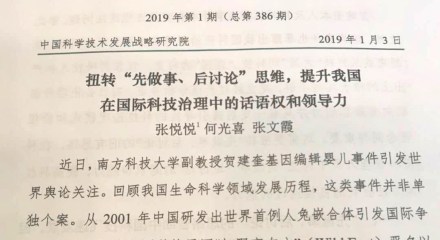
I’m really delighted to share the news that on 3 January 2019, Ministry of Science and Technology in China has officially accepted a set of policy recommendations on increasing transparency and public accountability of Chinese science and have circulated these recommendations in their Neican. ‘Neican’ refers to valued policy submissions which are put forward to ministers and other … Continue reading

