
Two Science Diplomacy Discussions
It has been a full few months of science diplomacy conversations—beginning in January with a US–UK bilateral meeting on ‘Knowledge Diplomacy as a Response to Knowledge Under Threat’, organised by the Royal Society and the American Academy of Arts and Sciences, and followed in March by a UK–Australia-focused conference, ‘Science & Conflict: Science Collaboration in a Geopolitically Fragmenting World’, co-organised by Birkbeck University. UCL, the Royal Society, RUSI, and the Australian Academy of Science.
Although distinct in format and focus, both gatherings circled around a shared concern: what happens when knowledge is no longer a stable anchor in public life, but becomes fragile, exposed to political contention and geopolitical instability?
Across both conversations, there was a clear recognition that knowledge is under pressure—not only from misinformation, but from deeper structural shifts. The March discussions brought this into sharper relief. Scientific collaboration is increasingly entangled with geopolitical realities: sanctions, security concerns, and fractured alliances all shape what research is possible, with whom, and under what constraints.
My key takeaway from these meetings is that diplomacy is no longer central to how knowledge itself is sustained, but it also calls for a more careful—indeed, care-full—approach. A form of diplomacy that attends to power asymmetries in realpolitik, but creates conditions for ongoing dialogue, often in the absence of agreement.
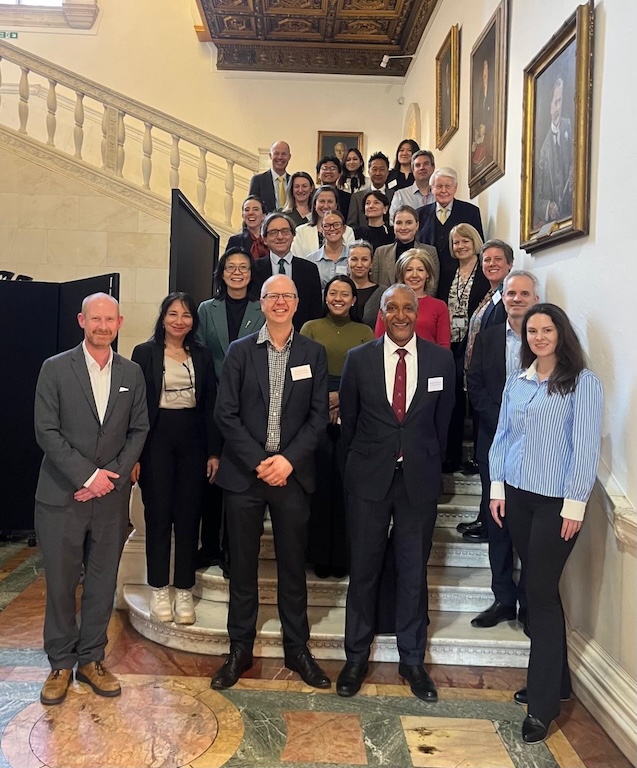
(group photo from the March meeting)
 Joy Zhang